

Work as an electrician in Greenland: authorization, jobs, and conditions
16 November 2026
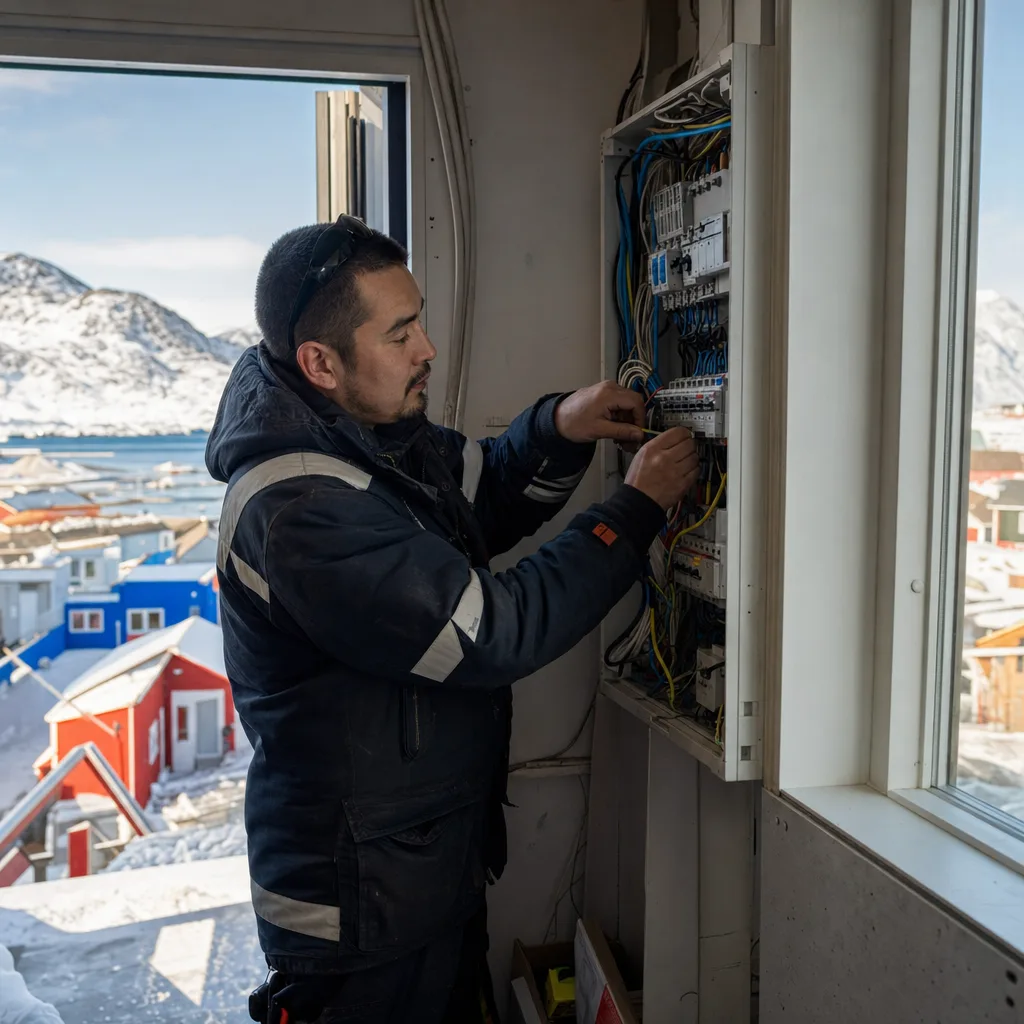
There is a need for electricians throughout Greenland – from new construction in Nuuk to operation and troubleshooting in smaller towns and settlements, where electricity, heating, and communication must function year-round. Here you get a practical overview of the profession, authorization, typical workplaces, and terms, so you can assess whether an electrician job in Greenland is right for you.
What does an electrician do in Greenland in practice?
The tasks are very similar to those in Denmark, but the conditions make the difference: large distances, changing weather, and periods where materials or spare parts cannot be obtained from day to day. This means that planning, documentation, and the ability to make a solution work in reality are highly valued.
- Installation and service in homes, institutions, and businesses: panels, lighting, sockets, data, fire/ABA, access control.
- Construction and civil engineering tasks: temporary construction power, coordination with other trades, handover, and quality assurance.
- Operation and maintenance in public buildings: schools, nursing homes, offices, sports halls, workshops.
- Energy and supply: working close to production and distribution, as well as troubleshooting where uptime is critical.
- Travel tasks to smaller locations: planned trips or urgent calls, often with tight time windows.
In larger cities like Nuuk, Sisimiut, Ilulissat, Qaqortoq, and Aasiaat, there are often specialized teams. In smaller towns, you can get a broader range of tasks and more responsibility – in return for having fewer colleagues to consult with on a daily basis.
Authorization and paperwork: what you need to be aware of
Electrical work is a regulated area. The requirements depend on the position, the employer's role, and whether you need to perform authorization-requiring work independently or be part of a team with a responsible installer. Therefore, you should always read the job posting carefully and ask questions before you accept.
Typically, employers will ask for:
- Certificate as an electrician (or documentation of equivalent education and experience).
- Relevant experience with service, construction site, or operation – depending on the job.
- Driver's license (often a plus, especially outside the largest cities).
- Documentation and order: ability to follow procedures, drawings, quality assurance, and safety regulations.
If you have education from Denmark or another country, there may be a need for assessment or supplementary documentation. Ask the employer what they expect, and be prepared to send diplomas, certificates, references, and a brief overview of your skills (e.g., panel work, data, fire, CTS, industry).
Language can also play a role. Danish is used in many places for documentation and collaboration, but Greenlandic is a significant advantage in local communities and in customer contact. English may be relevant on larger projects with mixed teams.
Where to find electrician jobs in Greenland – and who hires?
When people search for “electrician Greenland” or “electrician jobs Greenland,” it rarely concerns one type of employer. You can encounter both public and private workplaces, and the tasks vary greatly from place to place.
The most common employers are:
- Electrical contractors and installation companies: service, renovation, new construction, and project tasks.
- Supply and operation: production/distribution, maintenance, and emergency response.
- Public employers (Self-Government, municipalities, institutions): operation of buildings, schools, and facilities.
- Larger private workplaces: e.g., airport operations, ports, hotels, industry, and contractor projects.
If you want a quick overview of the market, start by viewing all available positions in Greenland and filter by craft/technical. You can also get an idea of who is active by looking at companies in Greenland.
If you are considering broader opportunities as a craftsman in Greenland (e.g., because your partner is also looking for a job), it may make sense to read the general guide to working in Greenland first, so you know the practical framework.
Terms: housing, travel, taxes, and working hours (without glossing over)
Terms can look different depending on whether you are recruited from outside for a fixed-term contract or if you move permanently and become locally employed. Many are surprised by how much this affects finances and daily life.
- Housing: Some positions come with free or provided housing, others do not. Ask specifically: What does it cost? Is electricity/heating/internet included? What is the standard like?
- Travel: When recruited from outside, there may be agreements about travel to/from Greenland and possibly annual home trips. Get it in writing.
- Taxes and deductions: Taxes vary, and your situation (family, housing type, commuting) matters. Calculate beforehand before comparing with Denmark.
- Working hours and on-call duty: Operation and supply may mean shift arrangements. In project work, there may be peak loads when the weather and logistics allow it.
- Equipment and safety: Ask about work clothing, protective gear, training, and what standards are being followed.
Greenland is not “just Denmark with snow.” You often get more responsibility and more variety, but also days where the weather controls, and where you must keep a cool head when a mistake affects critical infrastructure.
Everyday life in Nuuk, Sisimiut, Ilulissat, Qaqortoq, Aasiaat, etc.
The cities are different, but there are commonalities: short commuting distances, closer communities, and a nature that you feel in the planning. In Nuuk, you can experience more large projects, more professionals, and a greater range of leisure activities. In Sisimiut and Ilulissat, there is often a mix of operation, service, and project tasks, where you quickly get to know each other. In Qaqortoq and Aasiaat, you can have a daily life with significant local impact from your work – and where flexibility is a strength.
For many, well-being is about being realistic: Winter darkness, wind, and changing flight/freight routes affect both private life and work. In return, you often get a strong colleague culture and a sense that your profession makes a visible difference.
How to get started: concrete next steps
- Define your profile: Service, construction site, operation, energy, data/fire – write it clearly in your CV.
- Gather documentation: certificate, course certificates, references, and a short list of relevant projects.
- Ask about terms before you apply or say yes: housing, travel, shifts, duration, start, and equipment.
- Be honest about your flexibility: Can you travel between cities? Are you okay with shifts? Can you take a fixed-term contract?
- Keep an eye on related industries if you want to expand your options. For example, you can read about jobs in agriculture, forestry, and fishing in Qeqertalik to see how demand can vary between trades and regions.
If you want to see what is open right now, check the current postings on HireMe.gl and search broadly for both “electrician,” “electrical installation,” “operation,” and “maintenance.”