

To work as a primary school teacher in Greenland
09 November 2026
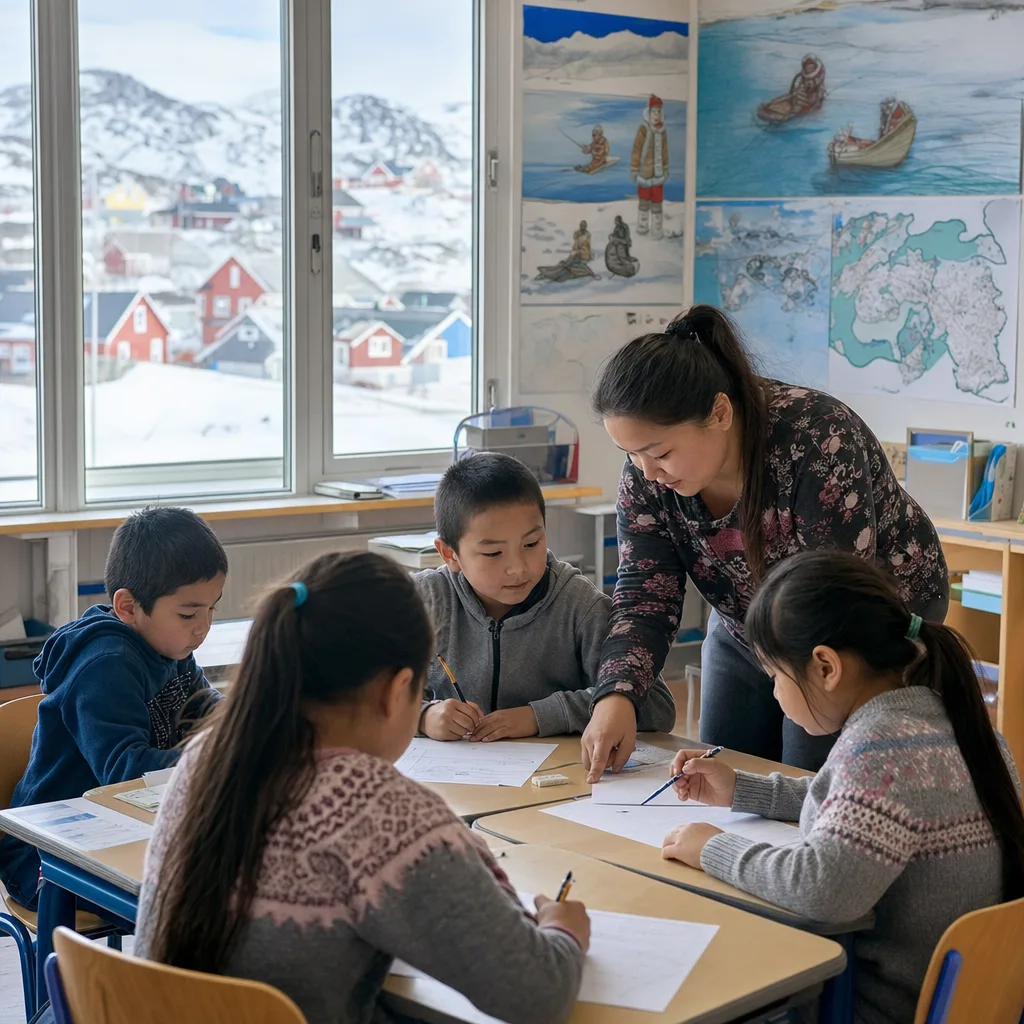
As a primary school teacher in Greenland, you are primarily a class teacher and relationship builder – and often more visible in the local community than many are used to from Denmark. You teach familiar subjects, but with different linguistic conditions, a different school culture, and close collaboration with parents, colleagues, and PPR/resource persons. Here you get an honest picture of the school, the subjects, the language, and everyday life – across Nuuk, Sisimiut, Ilulissat, Qaqortoq, Aasiaat, and more.
What does a primary school teacher in Greenland do in practice?
The positions resemble a Danish primary school on paper: teaching, preparation, student conversations, parent collaboration, and team meetings. In practice, the role is often broader. In smaller towns and settlements, you may have multiple subjects, several grade levels, or a combination of class teacher and subject teacher tasks, because the school is smaller and the schedule needs to work out.
You may also find that you spend more time creating structure and security in the classroom than on “covering the curriculum.” It is not about lower academic standards, but about the fact that everyday life can be affected by absenteeism, travel activities, weather, social conditions, or linguistic barriers. In return, you often receive close collegial support and a school where your efforts can be felt directly.
- The class teacher role is significant: well-being, absenteeism, contact with home, and coordination with resource persons.
- Interdisciplinarity is everyday: especially in early childhood and middle school, where teaching can be planned in sequences.
- Small teacher teams can mean short decision-making paths – and that you take on responsibility early.
The school and the subjects: familiar framework, local reality
You typically teach subjects such as Danish, mathematics, nature/technology, English, social studies, physical education, and creative subjects. Content and materials can vary between schools and municipalities, and in some places, access to books, copying, workshop facilities, and stable supplies may be more variable than what is known from larger Danish schools.
Local anchoring often plays a larger role: nature, seasons, hunting and fishing culture, the town's history, and current social conditions are relevant to integrate. For many who want to teach in Greenland, it is precisely the combination of professionalism and the reality of the place that makes the job meaningful.
In larger cities (e.g., Nuuk), you will more often encounter larger schools, clearer subject divisions, and more support functions. In medium-sized towns like Sisimiut, Ilulissat, Aasiaat, and Qaqortoq, there can be a mix: relatively good resources, but still a small environment where everyone knows each other. No matter where you are, it requires flexibility in planning and a practical approach to teaching materials.
Language in the school: Greenlandic, Danish – and everything in between
Language is the question that most people google first: “teacher in Greenland” and “primary school teacher Greenland” often concern how much Greenlandic one needs to know. The answer is that it depends on the position, the school, and the student group. Some positions are targeted at Danish-speaking subjects or upper grades, while others require Greenlandic as the working language.
In many classes, the reality is bilingual: students may be strong in Greenlandic, strong in Danish, or switch between the languages. As a teacher, you need to be able to navigate didactically in this – for example, with clear routines, visual support, repetitions, partner reading, and a focus on subject concepts. Collaboration with Greenlandic-speaking colleagues is often key if you are new to the language yourself.
- Inquire about the linguistic profile in the job posting and during the interview: teaching language, parent collaboration, and meeting language.
- Be realistic: You can start without fluent Greenlandic in some positions, but you must be willing to learn and use what you can.
- Plan for bilingualism: think language goals into subject goals, especially in Danish, mathematics, and natural sciences.
Employers, hiring, and the practical (housing, authorization, terms)
Primary schools are typically run by the municipalities, and many teachers are recruited from outside, especially for specific subjects or areas. Terms vary, and you should always read the specific posting carefully. Some positions may be associated with provided or temporary housing upon recruitment, while others require you to find something yourself. The housing situation can be tight – especially in larger cities – so that is one of the first things you need to clarify.
There may also be practical matters that weigh more than at home: moving, shipping belongings, travel planning, and seasonal opportunities for transport between towns. If you are considering moving, also read the guide: working in Greenland for an overview of taxes, housing, and everyday logistics.
Professionally, it is an advantage to have subject-specific training or solid experience in the subjects the school lacks. If you have special educational experience, Danish as a second language, reading guidance, or mathematics guidance, it can be relevant in many places. Requirements for education and any formalities may vary between positions – it is better to ask once too much than too little.
Life as a teacher: climate, closeness, and pace
Everyday life feels different because the frameworks are different. Weather and the dark season affect energy levels and planning, and at times outdoor life and community can be what gives you surplus. Many also experience that the boundary between work and leisure must be managed consciously: You meet students and parents in the store, in the hall, and at community events.
In return, you often gain a strong collegial bond. In some schools, there are many newcomers; in others, most are locals, and you need to spend time understanding norms, communication, and expectations. Approach the task with curiosity: Ask, listen, and be clear about your own boundaries.
- Well-being comes first: both yours and the students'. Establish fixed routines early.
- Be outdoors: many actively use nature in teaching and leisure – it also helps with your own adjustment.
- Build networks: local community life, colleagues, and parents can make the move significantly easier.
How to get started: concrete next steps
- Find the right type of position: Look for subjects, grade levels, and language requirements that match you – and be honest about what you can handle from day one.
- Ask questions before you say yes: housing, meeting language, class sizes, support functions, materials, and expectations for parent collaboration.
- Prepare your teaching for bilingualism: plan conceptual work, differentiation, and routines for students with different linguistic strengths.
- Research the employer: get a sense of the place through companies in Greenland and the school's/municipality's frameworks.
- Have a plan B for leisure: the dark season and distances can be an adjustment; agree in advance on how you will create a social life.
If you are curious about other sectors and combination opportunities (e.g., if your partner is also looking), you can also see the guide Jobs in tourism in Greenland – roles, requirements, and everyday life.
See current teaching jobs and other opportunities under view all available positions in Greenland on HireMe.gl, and read each posting as a concrete offer with local terms – that is where the details are.