
Languages at work in Greenland: Greenlandic, Danish, and English
21 September 2026
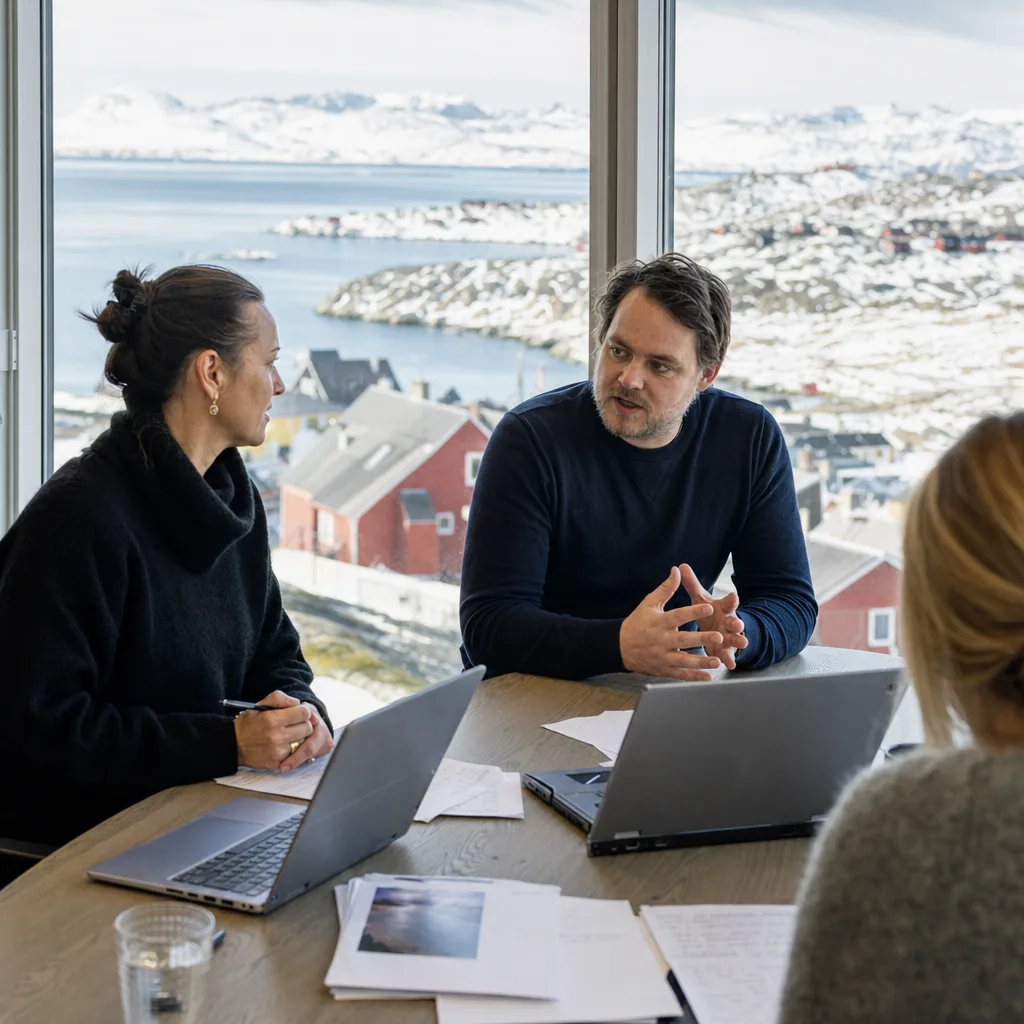
You can get a job in Greenland without knowing Greenlandic, but you can rarely have a good working life without engaging with the language. Which language is "valid" depends on the industry, workplace, city, and your role – and it often changes throughout the same day.
How languages typically distribute in everyday life
Greenland is effectively trilingual in working life. Many meetings start in Danish, switch to Greenlandic, and end with a few English sentences to a colleague or guest. This is normal, and for most locals, it is part of everyday competence.
- Greenlandic (kalaallisut) is most prevalent in contact with citizens, customers, and patients – and in informal conversations in many workplaces.
- Danish is widespread as a working language in many public functions, in larger workplaces, and in some written documentation.
- English especially appears in tourism, research, international collaborations, and among newcomers in workplaces with mixed teams.
In Nuuk, Sisimiut, and Ilulissat, there are often more newcomers and more workplaces where Danish and English are more prominent. In smaller towns and settlements, Greenlandic can be clearly dominant – especially in service and citizen-facing functions.
When Greenlandic is a must – and when it is "just" an advantage
The most important question is not which language is listed in the job advertisement, but who you need to understand and be understood by.
Greenlandic is often necessary when you:
- have daily, unpredictable contact with citizens/customers, where misunderstandings have consequences (e.g., parts of elderly care, social services, local customer service)
- need to catch nuances, culture, and "what is not said" in a local community
- work alone or in small teams, where informal communication takes place in Greenlandic
Greenlandic can be a great advantage when you:
- want to find it easier to become part of the community at the workplace
- need to solve tasks in collaboration with many different professional groups locally
- would like to move from "professionally strong newcomer" to key person in an organization
In many places, there are solutions with interpretation or colleagues who take the Greenlandic part of the conversation. This can work for periods, but it is vulnerable during busy times, illness, and shift schedules. Therefore, you often see phrases like "Greenlandic is an advantage" – not as decoration, but because it makes everyday life more robust.
Danish at work in Greenland: who uses it, and what is it used for?
Danish in Greenland is for many a practical working language, especially in written tasks and across units. In parts of the public sector – the Self-Government, municipalities, and healthcare – Danish can be central in:
- record-keeping, case processing, and reporting
- guidelines, instructions, and collaboration with Danish actors
- internal communication in larger workplaces with many newcomers
However, Danish is rarely "the only" language. If you only speak Danish, you can solve many tasks, but you may also end up outside the conversations where local knowledge and relationships are formed. It is worth being honest about this from the start – and asking how the team actually communicates in everyday life.
If you are considering moving, also read the guide to working in Greenland for a broader overview of conditions and practical matters.
English: when it is enough – and when it is not
English can be your most important language in tourism, hospitality, expeditions, research, and in workplaces with international employees. In places like Ilulissat and Nuuk, you may encounter teams where English is the common denominator in the lunchroom.
That said: English alone can be difficult if the job requires close citizen contact, or if you need to understand local expectations, humor, and indirect messages. Many misunderstandings in Greenland are not about professionalism, but about communication and pace: short messages, a lot of implicit knowledge, and great variation from place to place.
If you are curious about the industry, check out the guide to jobs in tourism in Greenland, where the language situation is often central.
How to read a job advertisement (and ask the right questions)
The text in a job advertisement does not always tell the whole truth about "language at work in Greenland." Use the advertisement as a starting point – and get the rest of the picture in the dialogue.
- Look for whether it states "working language," "language requirements," "knowledge of Greenlandic/Danish/English," or "speaks and understands." This says something about the level.
- Ask directly: What language are staff meetings conducted in? What language is training conducted in? Who do I speak with on the phone daily?
- Clarify writing: Do you need to write cases, journal notes, reports, or customer communication – and in what language?
- Ask about support: Is there interpretation? Are there templates? Are there colleagues who can help in citizen contact?
A practical tip: If the employer is recruiting broadly, the requirements may be flexible, but that also means you need to take responsibility for getting into the language over time.
Get far without knowing everything: realistic strategies for newcomers
If you come with Danish or English, you can often start in a role where you solve the core task and learn the rest along the way. However, it requires a plan; otherwise, the language becomes a wall instead of a door.
- Learn the "work phrases" first: greetings, numbers, times, polite standard phrases, and the 20 words you hear every day at your workplace.
- Get a buddy: Agree with a colleague that you can ask "what was said?" without feeling like you are disturbing.
- Hold on to the little Greenlandic: A few sentences in Greenlandic can change the entire relationship in a store, at an office, or in home care.
- Be clear about your limits: Say early what you can and cannot do, so no one thinks you understood something you did not.
And remember: Language is also about culture. In some environments, it is normal to be more indirect, to use silence, and to clarify things over time. This is not "wrong communication" – it is just a different rhythm.
If you want to see which languages are in demand right now, check out all available positions in Greenland and read company profiles under companies in Greenland on HireMe.gl.